Buy bbio-project.eu ?
We are moving the project
bbio-project.eu .
Are you interested in purchasing the domain
bbio-project.eu ?
domain@kv-gmbh.de · 0541-91531010
Buy bbio-project.eu ?
Why don't atoms fly apart due to electrical repulsion?
Atoms don't fly apart due to electrical repulsion because of the strong nuclear force that holds the protons and neutrons together in the nucleus. This force is much stronger than the electrical repulsion between the positively charged protons in the nucleus. Additionally, the electrons surrounding the nucleus are attracted to the positively charged protons, creating a balance of forces that keeps the atom stable. Overall, the combination of the strong nuclear force and the attraction between electrons and protons overcomes the electrical repulsion, preventing atoms from flying apart. **
On which two assumptions is the electron pair repulsion model based?
The electron pair repulsion model is based on two assumptions: first, that electron pairs in the valence shell of an atom repel each other and will arrange themselves in a way that minimizes this repulsion. Second, the model assumes that the repulsion between different pairs of electrons follows a specific order of strength, with lone pair-lone pair repulsions being the strongest, followed by lone pair-bond pair and bond pair-bond pair repulsions. These assumptions help to predict the geometry of molecules based on the arrangement of electron pairs around the central atom. **


Similar search terms for Repulsion
Top-Angebote
Products related to Repulsion:
-
Wayland ltd Comic Strip Science Series 4 Books Collection Set (Biology, Chemistry, Physics, Earth and Space)Comic Strip Science Series 4 Books Collection Set By Paul Mason (Biology, Physics, Earth and Space & Chemistry): Biology: Comic Strip Biology makes learning about the science behind animals, plants and the human body fun! Each spread in this series features a short, funny comic strip that explains a process or aspect of science. Around the strip, diagrams and panels give further information on the topic. They are a fantastic way to engage children aged 8 plus with science. Physics: Comic Strip Physics makes learning about the science behind forces, energy and simple machines fun! Each spread in this series features a short, funny comic strip that explains a process or aspect of science. Around the strip, diagrams and panels give further information on the topic. They are a fantastic way to engage children aged 8 plus with science. Earth and Space: Find out about the science behind the solar system, the big bang, gravity, black holes and much more with hilarous cartoon strips, facts and diagrams.Each spread in this series features a short, funny comic strip that explains a process or aspect of science. Around the strip, diagrams and panels give further information on the topic. They are a fantastic way to engage children aged 8 plus with science. Chemistry: Comic Strip Science: Chemistry makes learning about the science behind behind materials fun! It covers topics such as different states of matter, changing states, atoms and much more.Each spread in this series features a short, funny comic strip that explains a process or aspect of science. Around the strip, diagrams and panels give further information on the topic.12,89 £*Shipping: 2,99 £Secure redirect to the provider
-
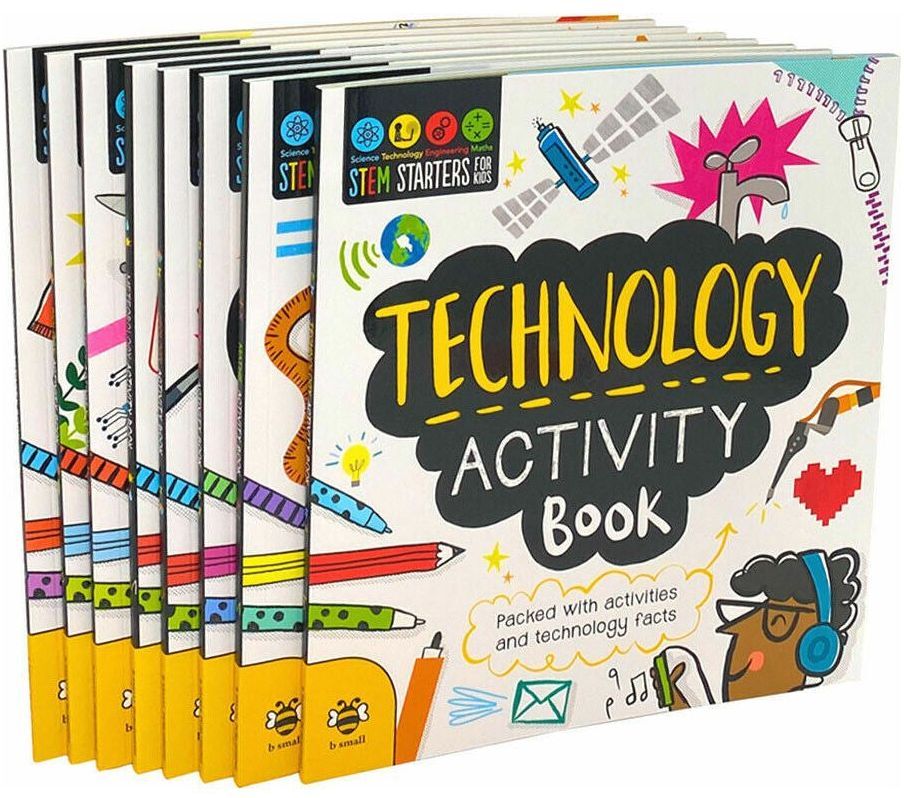
B Small Publishing STEM Educational Activity 8 Books Collection Set STEM Starters for Kids Science, Biology, Maths, Engineering, Meteorology for Early LearnersInspire curiosity and a love of learning with the STEM Educational Activity 8 Books Set, specially designed to introduce children to key STEM subjects through fun, hands-on activities. This engaging STEM Starters for Kids collection covers essential topics such as Maths, Engineering, Meteorology, and core scientific concepts, helping young learners build problem-solving skills, logical thinking, and creativity. Each book features age-appropriate explanations, interactive exercises, and simple activities that make complex ideas easy to understand. Ideal for home learning, classrooms, homeschooling, and after-school enrichment, this 8-book set supports early educational development while keeping children motivated and confident in STEM subjects. Why Parents & Educators Love This Set: 8 educational STEM activity books in one collection Introduces Maths, Engineering, Meteorology & Science Encourages critical thinking and problem-solving Hands-on activities that make learning fun Suitable for ages 5–10 Perfect for home, school, or gift giving A strong foundation for future learning, the STEM Educational Activity 8 Books Set helps children explore how the world works while developing essential academic and life skills. Science Activity Book In this particular title, little scientists will love the mix of non-fiction and activities in this educational book full of BIG ideas.Fun games and puzzles teach boys and girls about smells and taste buds, the power of magnetism, how sound travels and the different types of energy that fuel our lives and our world. Biology Activity Book Fun games and puzzles teach boys and girls about biology, plants, biomes, ecology, nature, digestion and the human body. Robotics Activity Book Fun games and puzzles teach boys and girls about robotics, automation, programming and engineering. Start a lifelong passion for STEM subjects. Meteorology Fun games and puzzles teach boys and girls about climates, the power of storms, how rain happens and the different ways of measuring the weather. Geology Fun games and puzzles teach boys and girls about rocks and fossils, the power of volcanoes, how earthquakes happen and the origin of the oil that fuels our lives and our world. Engineering Activity Book Fun games and puzzles teach boys and girls about structures that use science and technology to improve our lives. Engineering is what brings machines to life. Technology Activity Book Fun games and puzzles teach boys and girls about digital developments like mobile phones and the internet to more old-fashioned inventions like zips and door hinges. Maths Activity Book Fun games and puzzles teach boys and girls how to solve problems using addition, subtraction, multiplication and division.Maths is a huge part of science, technology and engineering.12,99 £*Shipping: 2,99 £Secure redirect to the provider

-
How do I describe the attraction or repulsion between electrically charged bodies?
The attraction or repulsion between electrically charged bodies is described by Coulomb's Law. This law states that the force between two charged objects is directly proportional to the product of their charges and inversely proportional to the square of the distance between them. If the charges are of the same sign, they will repel each other, while opposite charges will attract. The strength of the force depends on the magnitude of the charges and the distance between them. **
-
How does electromagnetism affect the attraction and repulsion of current in physics?
Electromagnetism plays a crucial role in the attraction and repulsion of current in physics. When an electric current flows through a conductor, it creates a magnetic field around it. This magnetic field can interact with other magnetic fields, causing attraction or repulsion between the currents. The direction of the current and the orientation of the magnetic fields determine the nature of the interaction. This phenomenon is fundamental to the operation of electric motors, generators, and various other electrical devices. **
-
Does the repulsion of like charges depend on the strength of the charge?
Yes, the repulsion of like charges does depend on the strength of the charge. The greater the charge of the particles, the stronger the repulsion between them. This is because the force of repulsion between like charges is directly proportional to the product of the charges and inversely proportional to the square of the distance between them, as described by Coulomb's Law. Therefore, the strength of the charge plays a significant role in determining the magnitude of the repulsive force between like charges. **
-
Is the repulsion of like charges dependent on the strength of the charge?
Yes, the repulsion of like charges is dependent on the strength of the charge. According to Coulomb's law, the force between two like charges is directly proportional to the product of the charges and inversely proportional to the square of the distance between them. This means that the greater the strength of the charges, the greater the repulsion force between them. Therefore, the strength of the charge does play a significant role in determining the repulsion between like charges. **
Which animal is suitable for a biology research project?
The choice of animal for a biology research project depends on the specific research question and the ethical considerations involved. For example, if the research involves studying mammalian physiology, mice or rats are commonly used due to their genetic similarity to humans. If the research focuses on behavior, social structure, or communication, animals such as primates or birds may be more suitable. It is important to consider the welfare of the animals and to use the most appropriate species for the research question while minimizing harm. **
What is the topic of the biology research project?
The topic of the biology research project is the impact of environmental factors on the growth and development of plant species. The project aims to investigate how variables such as light, temperature, and soil composition affect the physiological processes and overall health of different plant species. The research will involve conducting experiments and collecting data to analyze the specific effects of these environmental factors on plant growth and development. **
Top-Angebote
Products related to Repulsion:
-
CGP Books GCSE Combined Science: Biology AQA Revision Question Cards: superb for the 2024 and 2025 exams (CGP AQA GCSE Combined Science)It’s all very well reading through your study notes, but how much can you actually remember? Put your GCSE Biology knowledge to the test with CGP’s brilliant Revision Question Cards! There are 63 cards in the pack, covering all the key Biology topics from the Grade 9-1 AQA (Trilogy Specification) Combined Science course. Each one starts off with quick questions to warm you up, followed by harder questions to get your brain into top gear. Flip the card over and you’ll find full answers to each question, carefully written to help you understand everything you need to know. Along the way, we’ve packed in plenty of diagrams and expert revision tips, and there are even questions on Working Scientifically and Practical Skills. Amazing!6,95 £*Shipping: 2,99 £Secure redirect to the provider
-
CGP Books GCSE AQA Combined Science Revision Question Cards 3 Pack Set (Chemistry, Physics, Biology)To cut to the chase, there’s more to revision than just reading through study notes. If you really want to make sure you know GCSE Chemistry, Physics and Biology you’ll need to test yourself - and that’s where these CGP Revision Question Cards come in! There are 95 cards in the pack, covering every key Grade 9-1 AQA topic. Each one starts off with quick questions to warm you up, followed by harder questions to get your brain into top gear. Flip the card over and you’ll find full answers to each question, carefully written to help you understand everything you need to know. Along the way, we’ve packed in plenty of diagrams and expert revision tips, and there are even questions on Working Scientifically and Practical Skills. Amazing!21,99 £*Shipping: 2,99 £Secure redirect to the provider
-
Wayland ltd Comic Strip Science Series 4 Books Collection Set (Biology, Chemistry, Physics, Earth and Space)Comic Strip Science Series 4 Books Collection Set By Paul Mason (Biology, Physics, Earth and Space & Chemistry): Biology: Comic Strip Biology makes learning about the science behind animals, plants and the human body fun! Each spread in this series features a short, funny comic strip that explains a process or aspect of science. Around the strip, diagrams and panels give further information on the topic. They are a fantastic way to engage children aged 8 plus with science. Physics: Comic Strip Physics makes learning about the science behind forces, energy and simple machines fun! Each spread in this series features a short, funny comic strip that explains a process or aspect of science. Around the strip, diagrams and panels give further information on the topic. They are a fantastic way to engage children aged 8 plus with science. Earth and Space: Find out about the science behind the solar system, the big bang, gravity, black holes and much more with hilarous cartoon strips, facts and diagrams.Each spread in this series features a short, funny comic strip that explains a process or aspect of science. Around the strip, diagrams and panels give further information on the topic. They are a fantastic way to engage children aged 8 plus with science. Chemistry: Comic Strip Science: Chemistry makes learning about the science behind behind materials fun! It covers topics such as different states of matter, changing states, atoms and much more.Each spread in this series features a short, funny comic strip that explains a process or aspect of science. Around the strip, diagrams and panels give further information on the topic.12,89 £*Shipping: 2,99 £Secure redirect to the provider
-
B Small Publishing STEM Educational Activity 8 Books Collection Set STEM Starters for Kids Science, Biology, Maths, Engineering, Meteorology for Early LearnersInspire curiosity and a love of learning with the STEM Educational Activity 8 Books Set, specially designed to introduce children to key STEM subjects through fun, hands-on activities. This engaging STEM Starters for Kids collection covers essential topics such as Maths, Engineering, Meteorology, and core scientific concepts, helping young learners build problem-solving skills, logical thinking, and creativity. Each book features age-appropriate explanations, interactive exercises, and simple activities that make complex ideas easy to understand. Ideal for home learning, classrooms, homeschooling, and after-school enrichment, this 8-book set supports early educational development while keeping children motivated and confident in STEM subjects. Why Parents & Educators Love This Set: 8 educational STEM activity books in one collection Introduces Maths, Engineering, Meteorology & Science Encourages critical thinking and problem-solving Hands-on activities that make learning fun Suitable for ages 5–10 Perfect for home, school, or gift giving A strong foundation for future learning, the STEM Educational Activity 8 Books Set helps children explore how the world works while developing essential academic and life skills. Science Activity Book In this particular title, little scientists will love the mix of non-fiction and activities in this educational book full of BIG ideas.Fun games and puzzles teach boys and girls about smells and taste buds, the power of magnetism, how sound travels and the different types of energy that fuel our lives and our world. Biology Activity Book Fun games and puzzles teach boys and girls about biology, plants, biomes, ecology, nature, digestion and the human body. Robotics Activity Book Fun games and puzzles teach boys and girls about robotics, automation, programming and engineering. Start a lifelong passion for STEM subjects. Meteorology Fun games and puzzles teach boys and girls about climates, the power of storms, how rain happens and the different ways of measuring the weather. Geology Fun games and puzzles teach boys and girls about rocks and fossils, the power of volcanoes, how earthquakes happen and the origin of the oil that fuels our lives and our world. Engineering Activity Book Fun games and puzzles teach boys and girls about structures that use science and technology to improve our lives. Engineering is what brings machines to life. Technology Activity Book Fun games and puzzles teach boys and girls about digital developments like mobile phones and the internet to more old-fashioned inventions like zips and door hinges. Maths Activity Book Fun games and puzzles teach boys and girls how to solve problems using addition, subtraction, multiplication and division.Maths is a huge part of science, technology and engineering.12,99 £*Shipping: 2,99 £Secure redirect to the provider
-
Why don't atoms fly apart due to electrical repulsion?
Atoms don't fly apart due to electrical repulsion because of the strong nuclear force that holds the protons and neutrons together in the nucleus. This force is much stronger than the electrical repulsion between the positively charged protons in the nucleus. Additionally, the electrons surrounding the nucleus are attracted to the positively charged protons, creating a balance of forces that keeps the atom stable. Overall, the combination of the strong nuclear force and the attraction between electrons and protons overcomes the electrical repulsion, preventing atoms from flying apart. **
-
On which two assumptions is the electron pair repulsion model based?
The electron pair repulsion model is based on two assumptions: first, that electron pairs in the valence shell of an atom repel each other and will arrange themselves in a way that minimizes this repulsion. Second, the model assumes that the repulsion between different pairs of electrons follows a specific order of strength, with lone pair-lone pair repulsions being the strongest, followed by lone pair-bond pair and bond pair-bond pair repulsions. These assumptions help to predict the geometry of molecules based on the arrangement of electron pairs around the central atom. **
-
How do I describe the attraction or repulsion between electrically charged bodies?
The attraction or repulsion between electrically charged bodies is described by Coulomb's Law. This law states that the force between two charged objects is directly proportional to the product of their charges and inversely proportional to the square of the distance between them. If the charges are of the same sign, they will repel each other, while opposite charges will attract. The strength of the force depends on the magnitude of the charges and the distance between them. **
-
How does electromagnetism affect the attraction and repulsion of current in physics?
Electromagnetism plays a crucial role in the attraction and repulsion of current in physics. When an electric current flows through a conductor, it creates a magnetic field around it. This magnetic field can interact with other magnetic fields, causing attraction or repulsion between the currents. The direction of the current and the orientation of the magnetic fields determine the nature of the interaction. This phenomenon is fundamental to the operation of electric motors, generators, and various other electrical devices. **
Similar search terms for Repulsion
-
Does the repulsion of like charges depend on the strength of the charge?
Yes, the repulsion of like charges does depend on the strength of the charge. The greater the charge of the particles, the stronger the repulsion between them. This is because the force of repulsion between like charges is directly proportional to the product of the charges and inversely proportional to the square of the distance between them, as described by Coulomb's Law. Therefore, the strength of the charge plays a significant role in determining the magnitude of the repulsive force between like charges. **
-
Is the repulsion of like charges dependent on the strength of the charge?
Yes, the repulsion of like charges is dependent on the strength of the charge. According to Coulomb's law, the force between two like charges is directly proportional to the product of the charges and inversely proportional to the square of the distance between them. This means that the greater the strength of the charges, the greater the repulsion force between them. Therefore, the strength of the charge does play a significant role in determining the repulsion between like charges. **
-
Which animal is suitable for a biology research project?
The choice of animal for a biology research project depends on the specific research question and the ethical considerations involved. For example, if the research involves studying mammalian physiology, mice or rats are commonly used due to their genetic similarity to humans. If the research focuses on behavior, social structure, or communication, animals such as primates or birds may be more suitable. It is important to consider the welfare of the animals and to use the most appropriate species for the research question while minimizing harm. **
-
What is the topic of the biology research project?
The topic of the biology research project is the impact of environmental factors on the growth and development of plant species. The project aims to investigate how variables such as light, temperature, and soil composition affect the physiological processes and overall health of different plant species. The research will involve conducting experiments and collecting data to analyze the specific effects of these environmental factors on plant growth and development. **
* All prices are inclusive of VAT and, if applicable, plus shipping costs. The offer information is based on the details provided by the respective shop and is updated through automated processes. Real-time updates do not occur, so deviations can occur in individual cases. ** Note: Parts of this content were created by AI.